

Arturo
Torres Arpi
For a family-owned regional shoe retailer carrying roughly 3,000 SKUs across a full range of footwear, from children's sandals to specialized construction boots, inventory was everything. With product moving in and out of multiple store locations, the business depended on knowing what was selling, what was stagnating, and what to order next. When the current generation of ownership stepped in to manage the business, they inherited a company run almost entirely on instinct and tradition. There was no unified ERP. Key decisions came from a patchwork of spreadsheets, and some information was not even digital at all. "Some of the information we had was raw data without any pattern. I passed from 10 spreadsheets and even some information in a notebook, literally handwritten in a notebook, to a set of more than 30 dashboards."
The most pressing problem was inventory. The retailer was sitting on roughly 150 days of stock, a cash flow burden that was difficult to sustain. Without reliable data, it was nearly impossible to know which products were dragging and which were driving the business. What the business needed was not more data. It needed connection, structure, and clarity.
The retailer was not starting from zero. There was some data available: purchase records, inventory counts, sales history. But none of it was organized in a way that enabled real decisions.
The result: excess inventory piling up, slow-moving SKUs crowding out the assortment, and suppliers continuing to deliver products that were not resonating with customers, because no one had shown them the data to prove it.
The supply chain was not broken. The visibility was.
The relationship with Ventagium began the way many strong partnerships do: not through a formal RFP or a cold sales call, but through trust. The retailer's ownership had known Ventagium's founder since university, and when the idea for the company was first pitched, it aligned perfectly with the problems the retailer was trying to solve. What distinguished Ventagium from the start was not a technology pitch. It was a philosophy.
"They're not just trying to sell you some development or some IT solution. They are like: you must change the whole culture and the whole mindset of your company."
For a family business accustomed to traditional ways of working, that framing mattered. Ventagium did not lead with dashboards. They led with diagnosis, helping the team understand what the data was and was not telling them, and what would be possible if that changed. What began as an effort to clean up inventory data became the foundation of the company's first true supply chain analytics capability.
Ventagium's work began in parallel with the retailer's migration to NetSuite, a cloud-based, world-class ERP, a transition that created both opportunity and complexity. Rather than connecting to the new system after the fact, Ventagium worked alongside the ERP implementation team, acting as translators between the business and the technology.
The goal: ensure the data going into the new system was structured the right way from the start, so that everything built on top of it could be trusted.
From that foundation, Ventagium helped the retailer build an analytics infrastructure covering the full supply chain:
That last capability proved unexpectedly powerful. Many suppliers had never seen SKU-level sell-through data from their retail partners. Sharing it changed the conversation entirely, moving from reactive replenishment to collaborative assortment planning.
"Many of our suppliers didn't even know the information from their own SKUs. It was very interesting to see how we shared data and knowledge about our products and tried to change the type of product we were selling."
Within the first six months, the impact was measurable. By focusing first on the lowest-rotation inventory and using data to have targeted conversations with suppliers, the retailer reduced its inventory days from approximately 150 to 90 — a 40% reduction.
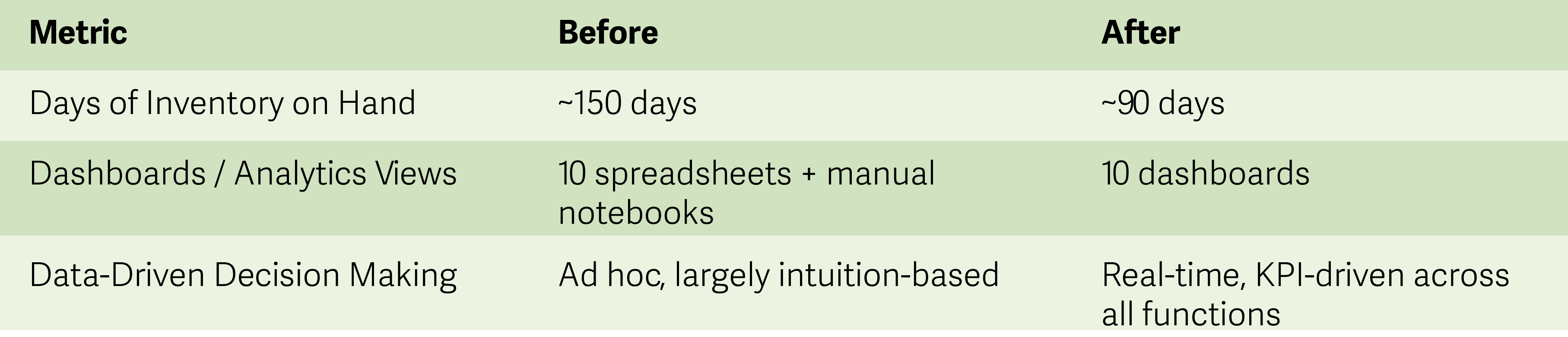
That reduction was not just a number on a spreadsheet. It was a direct improvement in cash flow, freeing up capital that had been locked in slow-moving product and putting it back into the business.
As the supply chain analytics capability matured, Ventagium's work expanded into store operations. One notable application was a customer-facing inventory tool that lets shoppers check in real time whether a specific style and size is available, not just at the store they are in, but across all locations. If the desired item is not in stock locally, the application surfaces which nearby store has it, and offers the option to have the purchase shipped directly to the customer's home.
What had previously required a manual check by a store associate became an instant, data-powered experience. The same inventory infrastructure built for supply chain planning was now driving customer service at the point of sale.
As Ventagium's engagement deepened, so did the technical architecture. The retailer's migration to a cloud-based ERP opened new possibilities, and Ventagium stayed ahead of them.
When the ERP provider launched a new generation of its data infrastructure, and when Microsoft released its Fabric platform for unified data and analytics, Ventagium proactively guided the retailer through integrating the two.
The result was a smoother data pipeline that makes it faster to build new dashboards, easier to develop real-time applications, and simpler to share reliable data across the organization. The architecture is designed not just for today's needs, but for the questions the business will need to answer next year.
"You don't get 'here's the solution, I'll see you in five years.' They are always improving, always tracking how you can improve your process even more with the newest tools."
Today, the retailer operates with a level of visibility that would have been unimaginable at the start of the engagement. The team tracks lead times by supplier and SKU, monitors inventory rotation and lifecycle across thousands of products, and shares performance data transparently with its supply partners. Decisions that once relied on experience and instinct are now grounded in evidence. The culture has shifted alongside the tools, from a business that managed inventory by feel to one that expects data to inform every significant call. The retailer now finds itself in an unusual position: its own suppliers seek insight into how their products perform. Some have begun exploring whether Ventagium might help them apply the same analytical rigor to their own manufacturing operations.
"Once you see the very first results, then you become a very strong proponent. You start chasing them: I want more changes, I want more technology, I want more developments."
The relationship endures because it was never just about dashboards. It was about trust, capability-building, and a shared belief that data-driven decisions produce better outcomes for the business, its people, and the partners it works with every day.
Ventagium. Clarity you can build on.