
Roberto
Hernández
Jiménez
As you likely already know, there is no such thing as a perfectly stable supply chain. In today’s volatile landscape, disruptions are the norm. Operational efficiency and business success depend on leveraging accurate and timely data to recognize and react to these inevitable disruptions quickly. Companies that rely on outdated or fragmented data architectures are losing millions, without even realizing it.
Your supply chain can generate an ocean of data every day - orders, shipments, inventory levels, supplier performance, and more. But is your data working for you or against you? Without the right architecture, that data becomes a liability instead of an asset.
Is your data working for you or against you? Without the right architecture, the oceans of data become a liability instead of an asset.
Data architecture refers to the structured framework that defines how data is ingested, processed, stored, and shared across enterprise systems such as ERP, WMS, TMS, and BI platforms like Power BI or Microsoft Fabric. It involves designing data pipelines, integration layers, metadata management, and governance policies to ensure seamless data flow, consistency, and real-time accessibility.
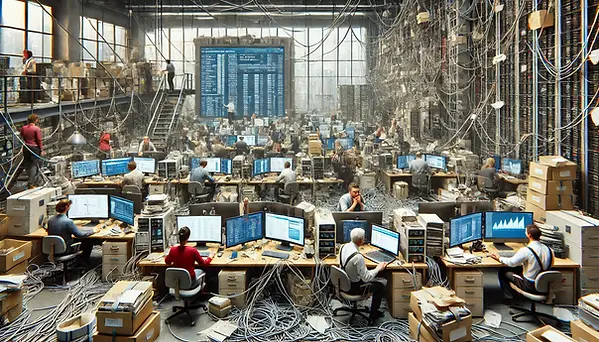
A bad data architecture is a tangled mess of legacy systems, redundant data, and manual processes. Silos block teams from accessing accurate insights, leading to inefficiencies, misaligned forecasts, and costly disruptions. Without a solid foundation, AI, automation, and real-time analytics become impossible, leaving you with fragmented systems, unreliable reports, and missed opportunities. This isn’t just a tech issue; it’s a bottom-line issue. If your team spends more time cleaning data than analyzing it, your architecture is holding you back.
Without a solid data architecture, organizations struggle to leverage AI, automation, and real-time analytics effectively.
The cost of poor data architecture can be felt immediately in impacts on operational performance, such as:
All this costs money. Take, for example, a Fortune 500 retailer who recently discovered that inaccurate demand forecasts were leading to $50M in excess inventory expenditure each year, all due to inconsistent data flows between their ERP, WMS, and BI platforms. Their critical error was not in the forecast solution, but in the quality of the data behind it! The ultimate culprit? A lack of unified data architecture.
Beyond immediate impact, however, inefficient data architecture can directly lead to longer term, systemic business issues, including:
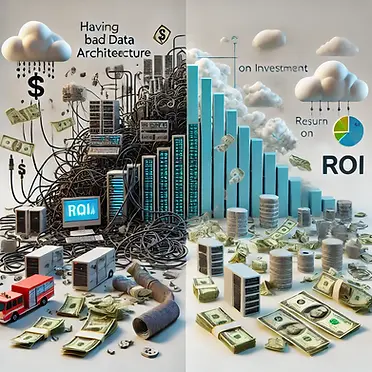
A robust data architecture leverages cloud storage, event-driven processing, and standardized data models to enable advanced analytics, AI-driven decision-making, and operational efficiency at scale. When built correctly, it turns raw data into a strategic asset, fueling automation, agility, and competitive advantage through the entire supply chain. The impact is felt across departments, tackling some of the most pressing operational challenges, including:
All these process improvements mean lower costs and better business profits. As an example, a global manufacturer recently leveraged a centralized data architecture to cut lead times by 25% and reduce stockouts by 40%. The ROI? Over $100M in annual savings.
Bad data drains your budget. A strong data architecture turns insights into action—and action into profit.
The companies winning in supply chain analytics aren’t just collecting data, they’re architecting it for speed, accuracy, and action. They aren’t asking if they need to modernize their data architecture, they’re asking how fast they can do it. Is your company’s data working for you or against you? If you’re unsure, it might be just time to rethink your approach before the next disruption costs you more than you can afford.
Are you ready to take control? Let’s talk.
Ventagium is a Data Consulting firm that provides high performance, self-sufficient teams to work full time on the solutions for your business in the fastest and most efficient way, helping you in Digital Transformation, Business Intelligence, and Data Science.
Read more: