AI agents are quickly moving from interesting experiments to software that companies expect to use every day.
That creates a practical architecture question: where should we actually build them?
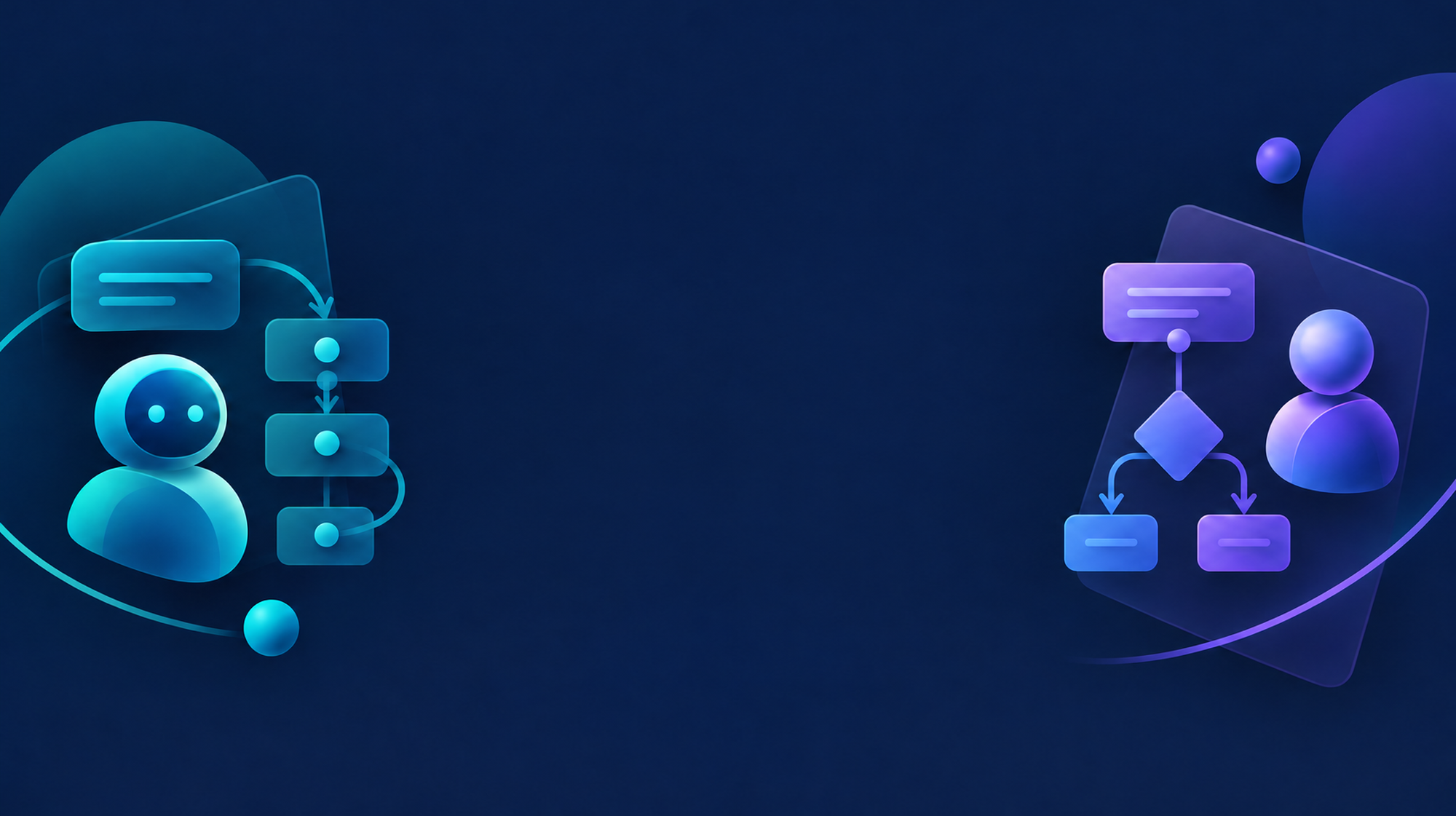
Within the Microsoft ecosystem, there are two main options: Microsoft Copilot Studio and Microsoft Foundry. At first glance, the choice can look like low-code versus pro-code. In reality, there is much more overlap. Copilot Studio has become considerably more capable, while Foundry has added visual development experiences that make it accessible beyond traditional software developers.
Certain authors will push the idea that you don't have to choose but if you are serious about your Agentic portfolio we see 3 disadvantages to building in two different platforms:
- Learning curve: each platform has its own quirks that your teams will have to learn.
- Setup and governance: each platform will require creating DevOps Pipelines, Connections, Roles, Permissions, doing this at scale for two platforms can get overwhelming. At scale, this adds administrative work and more opportunities for inconsistent configurations.
- Harder standardization: Different ways of building and operating agents make it harder to reuse components, establish consistent practices, and scale delivery.
Copilot Studio is usually easier to start with, particularly for Microsoft 365 scenarios and teams already comfortable with Power Platform. But if agents are expected to become an important software layer across the organization, we believe Foundry is the stronger foundation.
Here are ten reasons why.
1. More control over sophisticated agent orchestration
Foundry supports multi-agent systems through Microsoft Agent Framework and provides both code-first development and visual workflows.
The bigger advantage is control. Foundry supports multi-agent workflows where specialized agents can collaborate through defined orchestration patterns. Copilot Studio also supports agent-to-agent scenarios, but Foundry gives developers more direct control over how agents, models, tools, and workflows interact.
When orchestration becomes part of the application architecture, Foundry gives engineering teams more flexibility over how agents are built and coordinated.
2. Much broader model selection and fine-tuning
Foundry provides access to a large model catalog spanning Microsoft, OpenAI, Meta, Mistral, Cohere, and other providers. It also supports different deployment options and model customization, including fine-tuning for supported models.
Why does that matter?
Your invoice-processing agent may not need the same model as an agent performing complex planning. In Foundry, different agents can use models appropriate to their workload, allowing simpler tasks to run on smaller or cheaper models while reserving more capable models for harder problems.
Foundry also provides model routing capabilities designed to balance quality and cost.
Copilot Studio increasingly exposes model choice too, so this is not an exclusive Foundry capability. The difference is the breadth and level of control.
3. Reusable knowledge across agents
As the number of agents grows, rebuilding retrieval logic for every agent becomes difficult to maintain.
Foundry IQ provides reusable, permission-aware knowledge bases that can serve multiple agents.
Instead of configuring retrieval independently for every agent, teams can create a governed knowledge layer and connect multiple agents to it. This makes knowledge architecture easier to reuse as the number of agents grows.
Copilot Studio also supports enterprise knowledge sources, so the distinction is not simply that one platform has knowledge and the other does not.
The Foundry advantage is architectural: knowledge can become a shared service for an agent ecosystem instead of something primarily configured around individual agents.
4. DevOps feels more like traditional software engineering
Copilot Studio has proper application lifecycle management through Power Platform solutions, environments, pipelines, and source control integrations. But if you have ever had the experience of implementing DevOps for a Power Platform Solution, you will have experienced that it is far from ideal.
Foundry fits more naturally into workflows developers already use, including Git repositories, SDK-based configuration, Infrastructure as Code (IaC), Azure Developer CLI, GitHub Actions, and/or Azure DevOps.
That gives engineering teams more flexibility because agent configuration and infrastructure can participate in the same deployment processes as the rest of the application instead of requiring a separate Power Platform-specific ALM approach.
5. Observability becomes a platform decision
Foundry provides tracing, evaluation and monitoring capabilities through its observability stack, including integration with Application Insights and OpenTelemetry.
This becomes increasingly important as agent portfolios grow.
Gartner predicted that 40% of enterprise applications would include task-specific AI agents by the end of 2026.
That does not mean every company will suddenly operate hundreds of agents. It does suggest that agent estates could become large enough for monitoring architecture to matter.
If an organization splits its agent portfolio across multiple platforms, it also has to operate multiple monitoring and governance surfaces. Standardizing serious agent development around Foundry can simplify that problem.
6. Advanced RAG through Azure AI Search
Foundry integrates deeply with Azure AI Search and its agentic retrieval capabilities.
This gives developers control over retrieval techniques such as vector and hybrid search, semantic ranking, filtering, and query planning. Instead of simply connecting an agent to documents, developers can influence how information is indexed, retrieved, ranked, and returned to the model.
Copilot Studio can also use Azure AI Search, so the distinction is not access to search itself. Foundry is stronger when retrieval becomes part of the application architecture rather than simply a knowledge source.
7. Evaluations become part of development
Building an agent is relatively easy. Knowing whether it is getting better is harder.
Foundry includes evaluators for areas such as task completion, task adherence, intent resolution, tool-call accuracy and tool selection. Groundedness evaluations can also help identify answers that are insufficiently supported by retrieved information.
While both Copilot Studio and Foundry can run test sets, Foundry provides more granular control, larger datasets and flexibility. Foundry also provides continuous scoring of real production traffic and automated attack testing.
8. Agents as part of your Websites
For IT leaders, the question isn't whether a chatbot can be added to a website. It's whether it can be secured, governed, and supported like any other production system. Copilot Studio offers a fast path with an embeddable chat widget, but its web channels must be explicitly locked down, deeper integration runs through the Direct Line channel, and the user experience remains largely defined by the platform. Microsoft Foundry treats the agent as a managed application: it's published with its own endpoint and versioned releases, and it's called through a standard API from your own back end. That architecture keeps control where IT needs it. Authentication runs through Entra ID and managed identities rather than shared secrets, authorization and audit logging are enforced in your own services before any action reaches an ERP or other system of record, and the front end follows your existing security reviews and release pipelines.
Operationally, Foundry adds continuous evaluation and end-to-end tracing integrated with Azure Monitor, giving your team measurable quality, safety, and performance signals instead of anecdotal feedback. The result is a website chatbot that fits your existing identity, governance, and observability standards, which reduces long-term risk even if the initial build takes more engineering effort than a low-code alternative.
9. Granular identity and permissions
Both platforms now assign Microsoft Entra Agent IDs, giving agents their own identity in Entra for audit, lifecycle management, and Conditional Access. The difference is how that identity is used.
In Copilot Studio, the connectors an agent can use are governed by Power Platform data policies, which administrators configure in the Power Platform admin center and which Microsoft now enforces across all tenants. Agent connector permissions are also visible on the agent's Entra identity and can be targeted by Conditional Access.
In Foundry, published agents use their own identity to authenticate directly to Azure services and custom APIs, with access granted through Azure RBAC on a least-privilege basis. Foundry's advantage becomes more relevant when agents behave like independent software components that need narrowly scoped access to different systems beyond the Power Platform connector model.
10. Token-based costs are easier to connect to model usage
Copilot Studio uses Copilot Credits, with different capabilities consuming different numbers of credits.
Foundry model consumption is generally metered according to the models and services being used, commonly through input and output tokens plus any additional tool or infrastructure costs.
Tokens are not automatically cheaper, and pricing can become complicated when several Azure services are involved. The advantage is transparency at the model layer. Token consumption maps directly to a specific model and workload, making it easier to understand why one agent costs more than another. Therefore, making it easier to understand how to optimize costs.
Copilot Credits abstract several types of consumption into a common unit. That can simplify purchasing, but it can make the cost of an individual interaction less intuitive.
The 10 advantages at a glance
Foundry Advantages at Scale
| Foundry advantage |
Why it matters at scale |
| Multi-agent orchestration |
More control over complex workflows |
| Model selection |
Match model capability and cost to each agent |
| Reusable knowledge |
Share governed knowledge across agents |
| DevOps |
Fits standard engineering workflows |
| Observability |
Monitor quality, latency, and cost centrally |
| Advanced RAG |
Control how enterprise knowledge is retrieved |
| Evaluations |
Test agent quality systematically |
| AI + BI |
Embed agents into Fabric-based applications |
| Permissions |
Apply Azure identity and RBAC patterns |
| Token metering |
Connect model usage more directly to cost |
So, what are Foundry's disadvantages?
- The no-code option stops at single agents. Simple agents are fine without code. Anything with multi-step orchestration, branching or several agents working together will soon need Agent Framework code, because the visual workflow builder is being retired. Copilot Studio keeps that kind of logic (topics, flows, multi-agent handoffs) low-code, so makers can keep running it.
- Connecting to business systems takes more technical work. Copilot Studio uses the Power Platform connector catalog and DLP policies your IT team probably already manages. In Foundry, actions against business systems are usually set up as tools such as OpenAPI specs, MCP servers or Azure Functions. That typically needs someone comfortable with APIs, even if nobody writes much application code.
- You carry more Azure operations work. You're responsible for the Azure side: RBAC, networking, model deployments, quotas and cost control. Microsoft describes the hard part of agents as operational: where the agent runs, what identity it uses, and how the platform team monitors and rolls it back. One concrete example: if your project disables public network access, you can't publish to Teams from the portal and have to use the REST API instead. Copilot Studio hides most of this behind Power Platform environments and the admin center.
So, should everything move to Foundry?
No, Copilot Studio is a great place to start. But we believe that Foundry is the place to scale.
Copilot Studio makes a lot of sense when the goal is to get an agent into Microsoft 365 quickly, when Power Platform makers own the solution, or when the use case does not require extensive engineering control.
It is also easier to learn.
But the decision changes when agents become part of the organization's software architecture.
Foundry gives teams deeper control over orchestration, models, knowledge, retrieval, evaluation, identity, observability and cost. More importantly, it provides a common engineering foundation as the number of agents grows.
That learning curve requires an investment. For organizations planning serious agentic development, we think it is an investment worth making.