

Edgar
Cetina
Rodriguez
If you are building a budget for Microsoft Fabric, here is the direct answer.
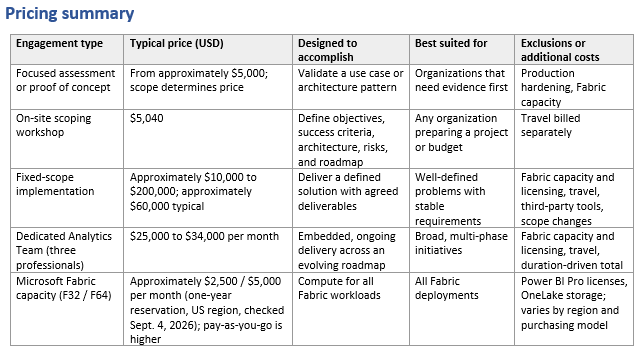
Microsoft Fabric implementation cost ranges from a small proof of concept or workshop to a multi-phase enterprise deployment. Based on Ventagium's engagement models:
These implementation prices do not include Microsoft Fabric capacity, licensing, consumption, travel, or third-party technology costs unless explicitly stated.
The range is broad because "implementing Microsoft Fabric" can mean anything from validating one use case to deploying a governed analytics platform across an enterprise. Your final investment depends on scope, data complexity, use cases, delivery model, organizational readiness, and capacity requirements.
Microsoft Fabric pricing is two separate budget categories, not a single number.
Microsoft Fabric is purchased primarily through Fabric capacities (F SKUs) in Azure, billed pay as you go per second or through discounted one or three year reservations. Among Ventagium customers, F32 and F64 are the most common capacities. As planning figures:
These correspond to the one-year reserved price on Microsoft's Azure pricing page for US regions as of September 4, 2026 (F32: $2,501.33; F64: $5,002.67 per month). Pay as you go was materially higher: approximately $4,204.80 and $8,409.60 per month respectively. Treat all of these as planning figures, not guaranteed prices.
Two licensing points matter. Users who create and publish Power BI content need a Power BI Pro (or Premium Per User) license regardless of capacity size. On capacities below F64, viewers also need a Pro or PPU license; on F64 and larger, free-license viewers can consume content, which often drives the F32-versus-F64 decision. OneLake storage is billed separately, but at 0.02 USD per GB, it tends to be negligible unless you are going to be storing terabytes of information.
Microsoft can change pricing, regions, purchasing options, and SKUs at any time. Verify current Microsoft Fabric licensing cost through Microsoft’s official Fabric pricing page, or the Fabric licensing documentation. If you are unsure which capacity SKU fits your workloads, or whether F32 or F64 makes more sense for you, send us your scenario and we will walk you through the trade-offs.
Implementation services cover the professional work to design, configure, build, test, secure, deploy, document, and operationalize the platform and its use cases. Keep the two as separate line items: licensing is recurring and scales with usage; implementation is largely one-time (fixed-scope project) or a predictable monthly rate (dedicated team).
Every proposal is a bundle of workstreams, which is why quotes vary so widely.
Not every project needs every component. A focused pilot may include only architecture, ingestion for two sources, one semantic model, and a set of reports.
Seven factors explain most of the variation between quotes. Each also hides costs that rarely appear in an initial estimate.
A discovery or scoping workshop is designed to surface these risks before the organization commits to a full project.
These scenarios are illustrative, not quotes.
One clearly defined use case, one to three data sources, a small group of users, and limited production hardening. A Microsoft Fabric proof of concept exists to answer a question, such as whether Fabric can support a workload or integrate a given source. Because hardening, documentation, and change management are intentionally limited, cost sits at the lower end of the range.
Multiple data sources, production pipelines, transformation and modeling, Power BI semantic models and reports, department-level security and governance, documentation, and knowledge transfer. This profile most closely matches Ventagium's typical project size of approximately $60,000 USD, depending on scope.
Multiple business units, numerous or complex source systems, several workloads, development, test, and production environments, advanced governance and security, machine learning or real-time analytics, change management, and a phased roadmap. Because priorities shift as the organization learns, this is better suited to a Dedicated Analytics Team or a multi-phase engagement than to a single, narrowly defined project.
Ventagium offers Microsoft Fabric consulting services through two models. Neither is universally better.
Ventagium provides an embedded analytics team with expertise aligned to your needs. Dedicated Analytics Engineers, sometimes described as Forward Deployed Engineers, operate as a unified team with your organization.
This model suits organizations with a large, evolving initiative; priorities likely to change; multiple processes to transform; a roadmap with several use cases; and a need for ongoing delivery capacity and continuity. Evaluate the expected duration when estimating the total annual investment.
Step 1: On-site workshop. Ventagium works with key IT and business stakeholders to define business objectives, success criteria, current-state challenges, target architecture, priorities, risks and dependencies, and the roadmap. The workshop costs $5,040 USD; travel is billed separately.
Step 2: Fixed-scope implementation. Based on the workshop findings, Ventagium defines scope, deliverables, assumptions, roadmap, and commercial estimate. Fixed-scope projects generally range from approximately $10,000 to $200,000 USD, with approximately $60,000 USD being typical.
This model suits organizations with a specific, well-defined business problem; clear deliverables and acceptance criteria; and a need for predictable scope and budget. Representative projects include a machine-learning solution to forecast demand, financial reporting such as a P&L or balance sheet, a governed departmental BI solution, or a specific data-integration or real-time analytics use case.
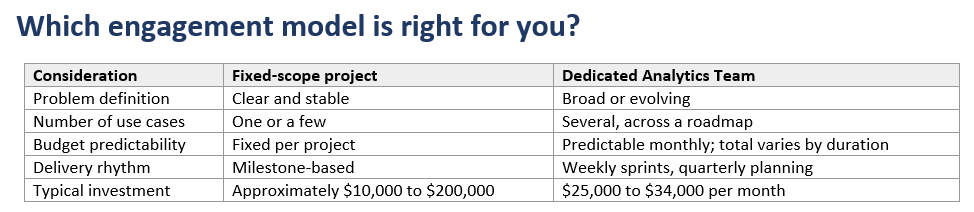
Choose a fixed-scope project when the problem, deliverables, stakeholders, data sources, and success criteria can be clearly defined. Consider a Dedicated Analytics Team when the initiative is broad, evolving, multi-phase, or part of a larger transformation roadmap.
Practical questions:
If most answers are uncertain, a scoping workshop is usually the right first step.
The usual contributors: scope expansion, undocumented source-system complexity, poor data quality, missing MDM capabilities, changing business requirements, new security or regulatory requirements, underestimated testing, higher-than-expected capacity needs, limited stakeholder availability, low adoption or insufficient change management, and attempting too many use cases at once.
Practical ways to reduce the risk:
Organizations beginning or planning a Microsoft Fabric initiative may be eligible for Microsoft-sponsored incentives or funding that could cover part of a proof of concept or implementation. Eligibility is not guaranteed; programs, conditions, amounts, geographies, and requirements change over time. If it helps, you can ask us and we will tell you whether your initiative is likely to qualify, and if not, what alternatives exist.
Schedule a 30-minute conversation with Ventagium to discuss your Microsoft Fabric goals, scope, implementation options, and realistic budget. The purpose is to determine the appropriate next step, not to deliver a sales pitch.
Pricing disclaimer: All prices in this article are planning ranges rather than binding quotes. Final pricing depends on scope, complexity, team composition, timeline, data readiness, capacity requirements, travel, and other project-specific factors. Microsoft licensing and capacity prices can change and may vary by region and purchasing model; figures were checked on September 7, 2026.